Neutrino News

What is happening in neutrino physics

This week's neutrino news is dominated by hardware and outreach: DUNE stress-tested a prototype detector module to 300,000 volts and is developing AI-based triggers ahead of its data-taking phase, while NOvA reported a high-statistics measurement of antineutrino-hydrogen scattering and IceCube described tools for using atmospheric neutrinos to probe the Earth's interior. On the theory side, published work spans global limits on the Majorana neutrino mass from neutrinoless double-beta decay, a benchmark of interaction models for argon-based detectors, and new links between neutrino-mass generation and dark matter.

Three-flavour oscillation (schematic)

Three-flavour oscillation, schematic — not a fit, and not to scale.

Experiment items
6
Published papers
6
Conferences ahead
31
Preprints in window
49

This page is generated automatically with AI and may contain errors. Every item links to the source it was written from — follow the link before citing anything here. Nothing on this page is a result of the Bari group unless it says so and links to the paper.

Last successful update: 15 August 2026, 07:32 CEST.

Experiments & results

Running and forthcoming experiments: recent measurements, results expected soon, construction and commissioning.

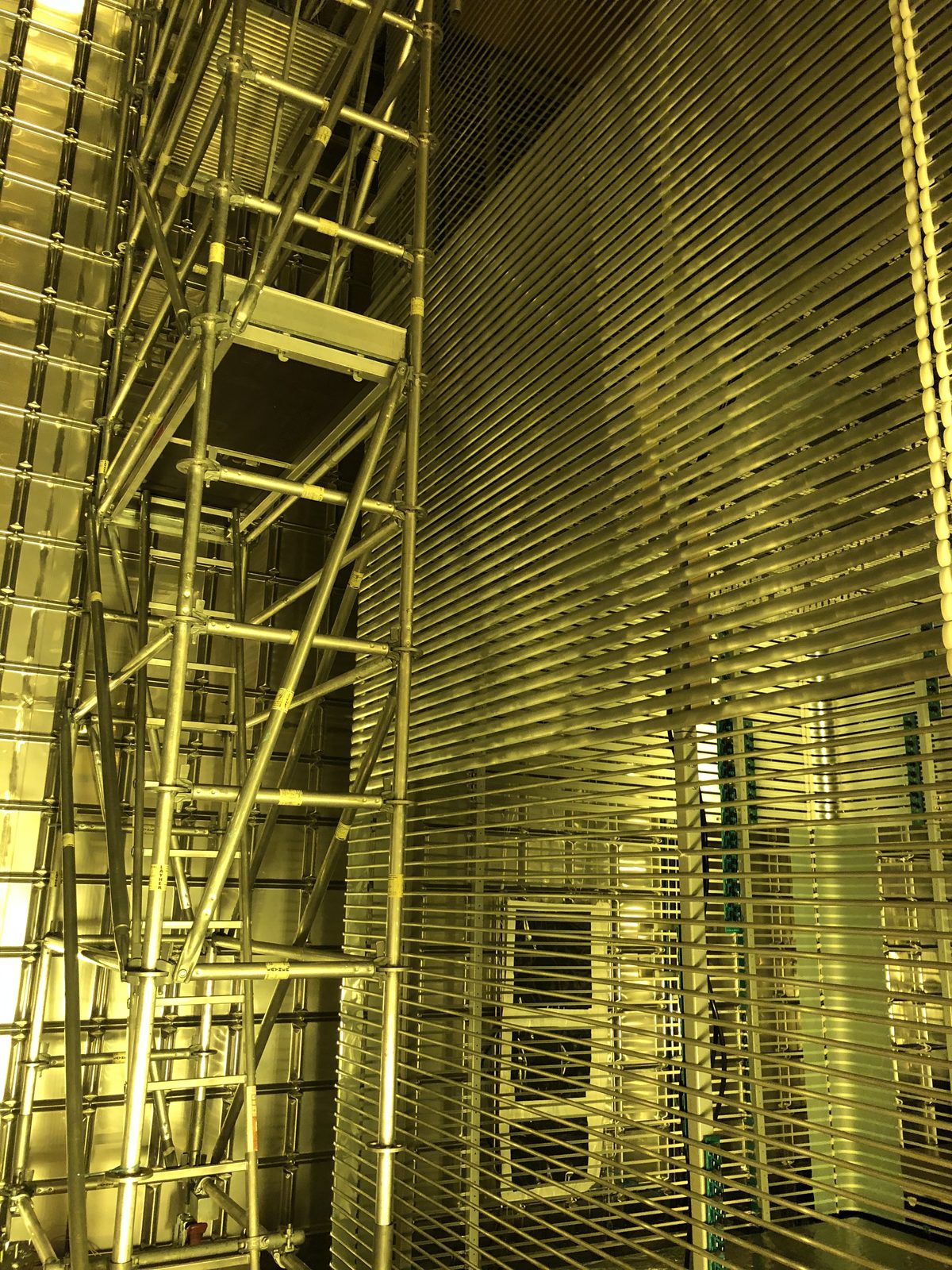
Inside the ProtoDUNE vertical-drift detector at CERN: field cage and steel walls of the liquid-argon chamber.
Inside the ProtoDUNE vertical-drift detector at CERN: field cage and steel walls of the liquid-argon chamber. Abitowlish, CC BY-SA 4.0.

DUNE data triggers

Researchers on the DUNE experiment are developing AI-based automated trigger systems to sort through the very large volumes of data the detector will produce, aiming to identify neutrino interactions, flag signs of a stellar explosion, and spot detector problems. The effort draws on decades of machine-learning work at Fermilab and is meant to prepare the collaboration for its data-analysis phase.
Sources: interestingengineering.com, 11 Aug 2026 · Fermilab News, 6 Aug 2026

Schematic of a long-baseline accelerator experiment: a proton beam makes neutrinos, a near detector measures the beam and a far detector, hundreds of kilometres away, measures it again.protonstargetnearνfarbaseline L
Long-baseline accelerator experiment — schematic, not to scale, and not a picture of any particular detector.

DUNE high-voltage test

A prototype module for the DUNE far detector was put through an extreme high-voltage stress trial, reaching 300,000 volts, ahead of its eventual installation deep underground in South Dakota. The test forms part of the collaboration's effort to establish the operating limits of the detector technology before construction of the full experiment.

Sources: interestingengineering.com, 31 Jul 2026

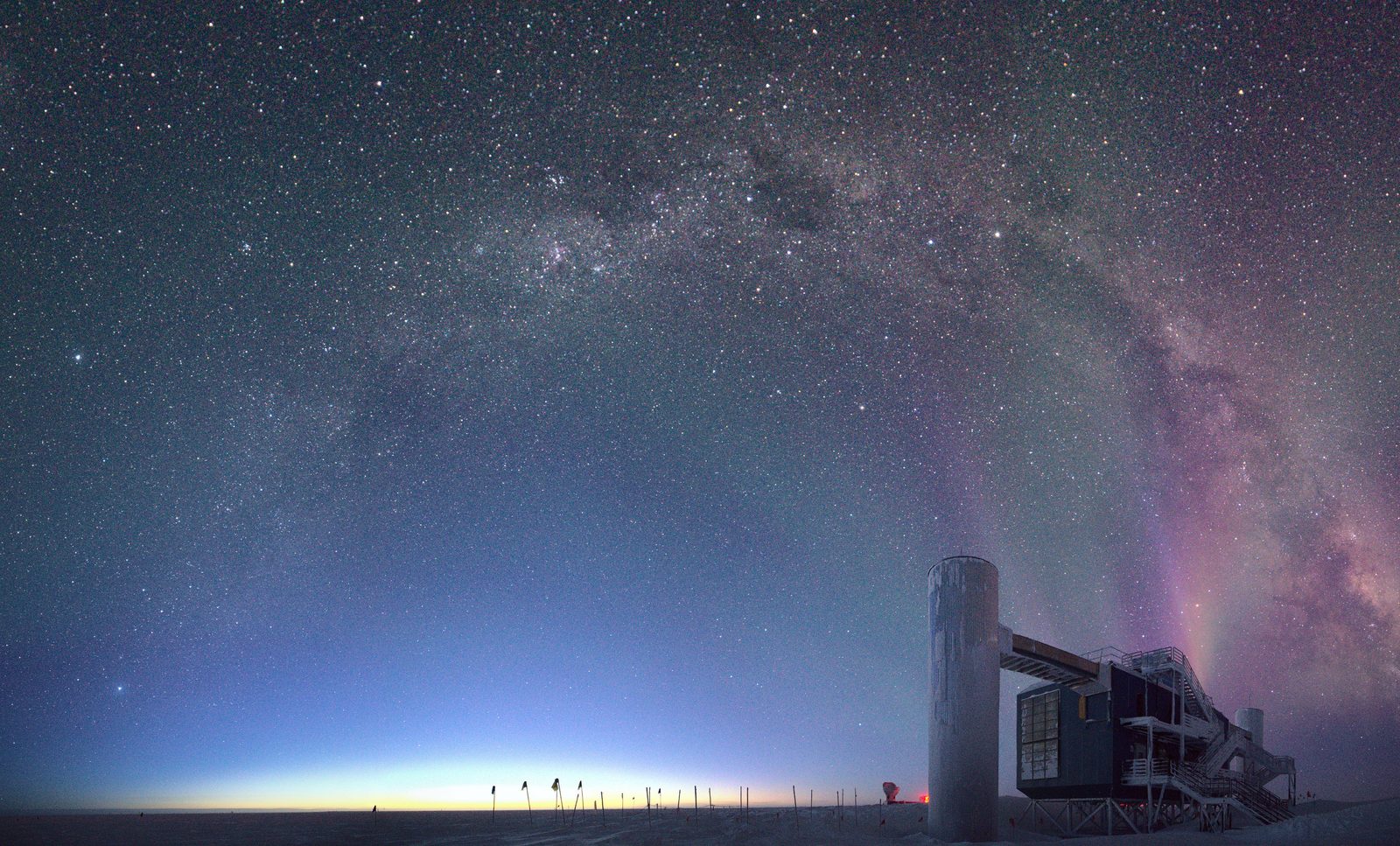
The IceCube Laboratory at the South Pole under a green aurora, with the Milky Way overhead.
The IceCube Laboratory at the South Pole under a green aurora, with the Milky Way overhead. John Hardin, CC BY 4.0.

IceCube Earth tomography

Atmospheric neutrinos, produced in cosmic-ray-induced air showers, are being used by the IceCube collaboration to probe the structure of the Earth's interior, complementing traditional seismic and gravitational measurements.

Sources: IceCube, 11 Aug 2026

Schematic of an atmospheric neutrino experiment: cosmic rays make neutrinos in the atmosphere, and the detector sees both those coming from above and those that crossed the Earth.Earthatmospherecosmic rayνdetectorν through the Earth
Atmospheric neutrino experiment — schematic, not to scale, and not a picture of any particular detector.

IceCube WavePID tool

A new reconstruction tool called WavePID identifies neutrino interactions in the IceCube detector from the nanosecond-level timing structure of the light patterns produced when a neutrino interacts with the ice.

Sources: IceCube, 17 Jul 2026

IceCube Upgrade calibration

At the South Pole, winterovers continued calibration work for the IceCube Upgrade alongside routine detector maintenance through the Antarctic winter.

Sources: IceCube, 24 Jul 2026

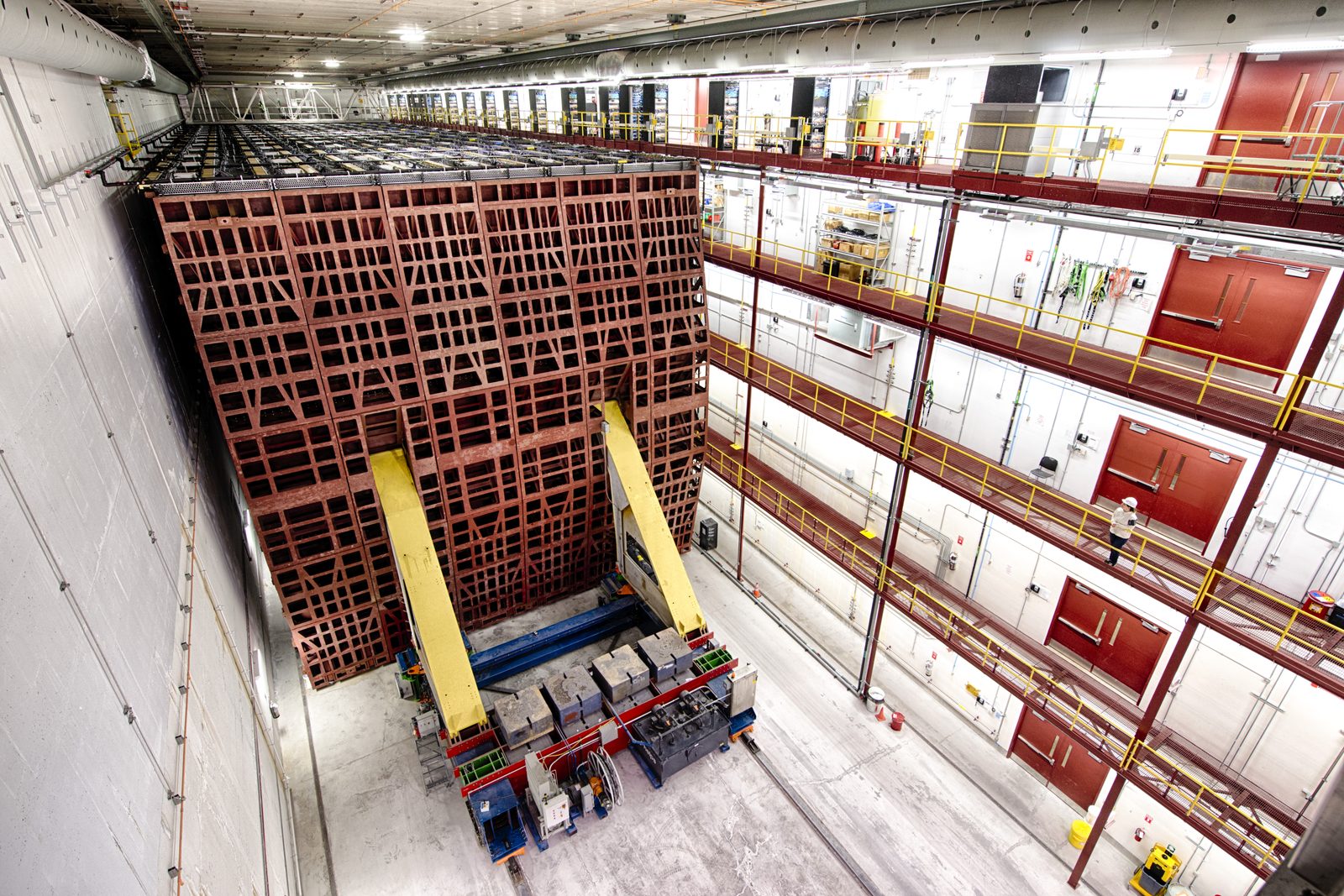
The 14-kilotonne NOvA far detector at Ash River, Minnesota, with a person at its base for scale.
The 14-kilotonne NOvA far detector at Ash River, Minnesota, with a person at its base for scale. Justinvasel, CC BY-SA 4.0.

NOvA hydrogen cross section

Using the near detector in the NuMI beam, the NOvA collaboration measured the muon antineutrino charged-current quasi-elastic cross section on hydrogen, selecting 35,509 signal events from a 1.2×10^21 protons-on-target exposure — the highest-statistics sample of antineutrino-hydrogen interactions measured to date. Backgrounds from interactions on heavier nuclei were constrained using dedicated data control samples, reducing the associated systematic uncertainties.

Sources: arXiv:2608.12293, 12 Aug 2026

Photographs reproduced unmodified except for resizing to the width of the page.

Theory highlights

Recently published papers, each with its arXiv preprint, INSPIRE record and journal DOI.

T. Shickele, L. Jokiniemi, A. Belley et al. · Phys.Rev.D 114 (2026) 013007

Combining likelihoods from the current generation of neutrinoless double-beta decay experiments with nuclear matrix elements computed ab initio from chiral effective field theory, the authors derive global Bayesian limits on the Majorana neutrino mass. Unlike phenomenological nuclear models, the ab initio calculation indicates that current-generation experiments have likely not yet reached the sensitivity needed to probe the mass region of interest.

arXiv · INSPIRE · DOI

Carlos A. Argüelles, José Bazo, Christopher Briceño et al. · Nature Astron. 10 (2026) 947

This paper presents TAMBO, a proposed mountain-based observatory that would detect tau neutrinos via air showers, aiming to map the high-energy neutrino sky in an energy range and angular region not well covered by existing telescopes. The authors argue the approach could also give access to new physics through tau neutrino interactions.

INSPIRE · DOI

Liang Liu, Steven Gardiner, Steven Dytman · Phys.Lett.B 880 (2026) 140750

Using the GENIE event generator, the authors benchmark a range of pionless neutrino-argon interaction models, including different nucleon form factors and nuclear ground-state treatments, against recent MicroBooNE charged-current measurements. They find that some model choices are much better separated by the data than others, providing concrete guidance for the interaction models used by current and upcoming argon-based neutrino experiments.

arXiv · INSPIRE · DOI

Mattia Di Mauro · Phys.Rev.D 113 (2026) 095035

The paper proposes a secluded dark-matter model with an extra U(1) gauge symmetry in which a Dirac dark-matter candidate, three heavy neutrinos, and a singlet scalar share the same Yukawa structure that generates light neutrino masses. Because the dark sector couples to the Standard Model only through this neutrino-mass-generating loop, the scalar mixing angle is tied directly to the heavy-neutrino masses, linking dark-matter phenomenology to the seesaw sector.

INSPIRE · DOI

Fang Xu · Phys.Rev.D 114 (2026) 015004

Working in R-parity-violating supersymmetry with a split slepton spectrum, the authors classify which trilinear LLE coupling patterns can generate neutrino non-standard interactions and confront the resulting parameter space with existing experimental constraints. They find percent-level non-standard interactions can be realised in some channels, reaching ϵ_ee ≈ 8% and ϵ_μμ ≈ 3.8% in the largest cases, with ϵ_μτ ≈ -0.3%, while other entries remain restricted to well below the percent level.

INSPIRE · DOI

Bin Pan, Xingming Fan, Yiwen Zhang et al. · JINST 21 (2026) P07023

The authors compare the gamma-ray response of Daya Bay's gadolinium-loaded liquid scintillator, JUNO's liquid scintillator, and the reference scintillator EJ-309, measured under identical conditions with Cs-137, Na-22, and Am-241 sources. Using Compton-edge positions extracted from the Cs-137 spectra, they determine the relative light yields to be (60.7 ± 0.2)% for the Daya Bay scintillator and (63.7 ± 0.2)% for the JUNO scintillator, each relative to EJ-309.

INSPIRE · DOI

Conferences

From the INSPIRE-HEP conference database and from Neutrino Unbound, the conference list maintained at INFN Torino by S. Gariazzo, C. Giunti and M. Laveder.

Conference timeline Sep TODAY ICNFP 2026 Kolymbari, Crete, Greece Corfu 2026 Corfu, Greece Multi-Messenger… Athens, Greece COSMO 2026 Leiden, Netherlands Multi-Higgs 2026 Lisbon, Portugal TeVPA 2026 Tendo, Japan NOW 2026 Otranto (Lecce), Italy PPC 2026 Sydney, Australia Gamma 2026 Heidelberg, Germany. NuFact 2026 Shanghai, China UNDARK 2026 CERN, Geneva, Switzerland CZ+SK HEP Workshop 2026 Prague Gravity@Prague 2026 New Physics from Galaxy…

Upcoming14

Recently concluded6

Across particle physics

The flagship series the field plans around — ICHEP, Moriond, LHCP, Quark Matter, SUSY and their neighbours.

Upcoming8

Recently concluded6

Where the meetings are Vancouver Los Angeles 3 University of… 2 Irvine Norman Pittsburgh Ottawa Valparaiso Harvard University 2 Natal Lisbon A Coruña Torremolinos Bilbao Blois Bures-sur-Yvette Paris-Saclay… Barcelona Paris Orsay & Paris Leiden Avignon Nikhef 5 CERN Geneva 3 La Thuile Nice Barolo Karlsruhe Heidelberg Milano Passo del Tonale 2 Bologna 2 Munich Bertinoro Rome 3 Erice Frascati (Rome) Gran Sasso… Sorrento Prague Catania Wrocław Lecce Otranto (Lecce) Corfu Ostroda Athens Kolymbari Aswan Moscow Sarov Quy Nhon Zhuhai Shanghai Seoguipo Seoul Daejeon Tendo Mito Sydney Neutrino Particle physics

Dots sit on the venue city (coordinates from OpenStreetMap; a venue that cannot be located falls back to the centre of its host country). A filled dot means the meeting is still ahead; a number, several meetings at the same place. Zoom in to see the venue names.

arXiv digest

The most relevant new preprints of the last few days, ranked by keyword. The full curated digest, with abstracts and a note on why each paper matters, is on its own page.

Resources

Where to look things up: experiments, parameters, reviews, databases.

Resources

Experiments

Official collaboration pages for the running and upcoming experiments.

  • JUNO — Medium-baseline reactor experiment, Jiangmen, China
  • DUNE — Long-baseline accelerator experiment, Fermilab to SURF
  • Hyper-Kamiokande — Next-generation water Cherenkov detector, Kamioka
  • Super-Kamiokande — Atmospheric and solar neutrinos, far detector for T2K
  • T2K — Accelerator long-baseline experiment, J-PARC to Kamioka
  • NOvA — Accelerator long-baseline experiment, Fermilab to Ash River
  • Short-Baseline Neutrino Program — SBND, MicroBooNE and ICARUS on the Fermilab Booster beam
  • IceCube — Cubic-kilometre neutrino telescope at the South Pole
  • KM3NeT — Deep-sea telescopes ARCA and ORCA in the Mediterranean
  • KATRIN — Direct neutrino mass from tritium beta decay
  • KamLAND and KamLAND-Zen — Reactor antineutrinos and xenon neutrinoless double beta decay
  • LEGEND — Neutrinoless double beta decay search with germanium-76
  • nEXO — Proposed tonne-scale liquid xenon double beta decay detector
  • SNO+ — Liquid scintillator detector at SNOLAB, tellurium loaded
Resources

Parameters and global fits

Where the current oscillation parameters and their uncertainties come from.

Resources

Reviews and lecture notes

Pedagogical entry points; arXiv identifiers checked against the abstract pages.

Resources

Databases and tools

Literature, data and simulation tools.

Resources

Outreach and magazines

News and general-audience coverage of particle and neutrino physics.