Interactive neutrino physics · Absolute masses
What do β decay, 0νββ and cosmology each measure?
mβ, mββ and Σ as functions of the lightest mass, the ordering and the Majorana phases, set against the current bounds.
Interactive figure
Neutrino mass observables
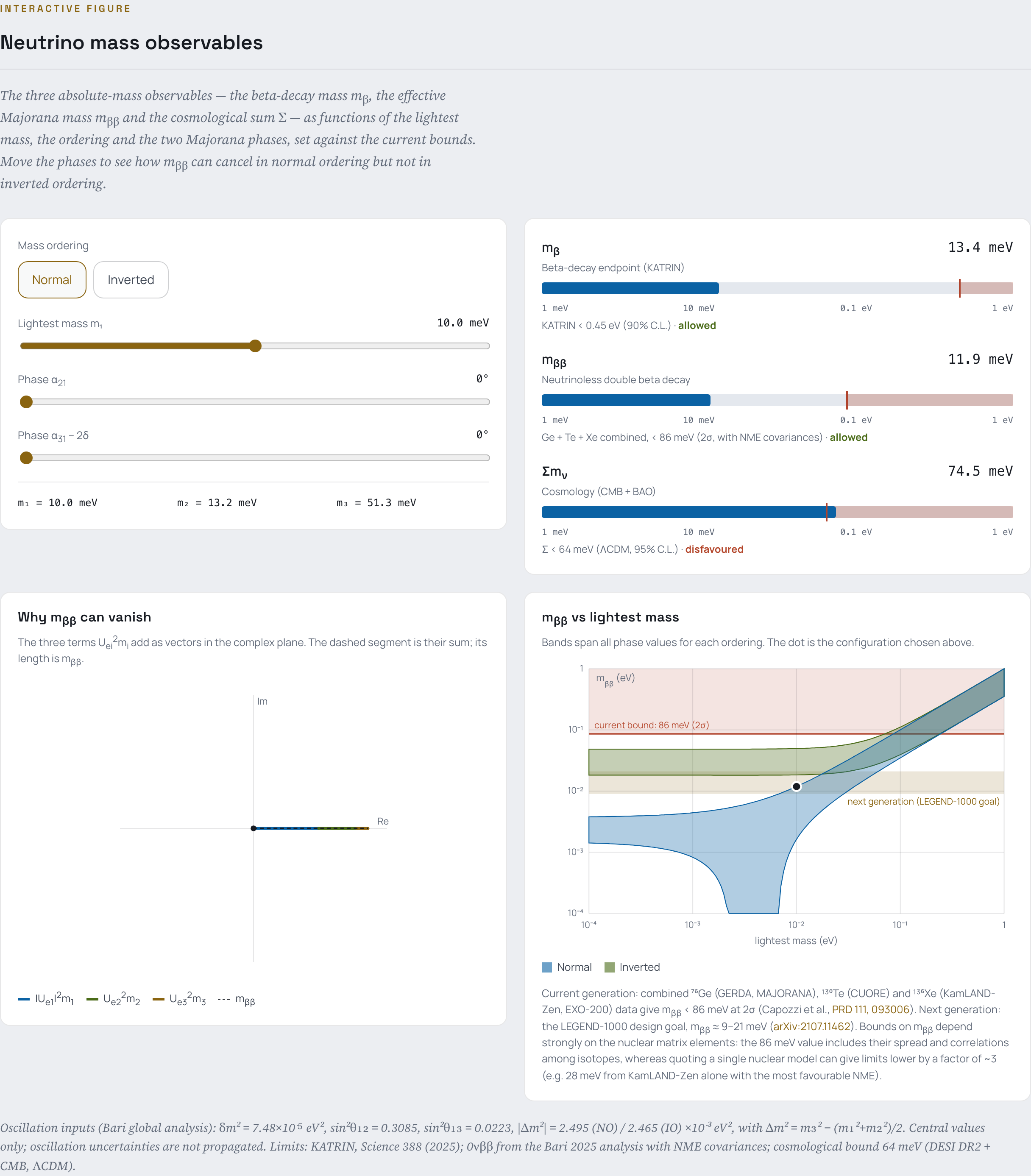
The three absolute-mass observables — the beta-decay mass mβ, the effective Majorana mass mββ and the cosmological sum Σ — as functions of the lightest mass, the ordering and the two Majorana phases, set against the current bounds. Move the phases to see how mββ can cancel in normal ordering but not in inverted ordering.
About this figure
Neutrino mass observables
Level. Advanced undergraduate to graduate.
Move the lightest mass and the two Majorana phases, switch the ordering, and watch the three observables against their bounds; the phasor sum shows why mββ can cancel in normal ordering but not in inverted ordering.
Assumptions
- Central oscillation values only; their uncertainties are not propagated.
- δm² = 7.48×10⁻⁵ eV² and sin²θ12 = 0.3085 (with first JUNO data), sin²θ13 = 0.0223, |Δm²| = 2.495 (NO) / 2.465 (IO) ×10⁻³ eV².
- Bounds: mβ < 0.45 eV (KATRIN, 90% C.L.); mββ < 86 meV (2σ, with nuclear-matrix-element covariances); Σ < 64 meV (DESI DR2 + CMB, ΛCDM, 95%). Next generation: the LEGEND-1000 goal, 9–21 meV.
References
Where it fits
Cite and reuse
A. Marrone, Neutrino mass observables, interactive figure (2026), https://home.ba.infn.it/~marrone/interactive-mass-observables.html.
@misc{Marrone:massobservables,
  author       = {Marrone, Antonio},
  title        = {Neutrino mass observables},
  howpublished = {Interactive figure, \url{https://home.ba.infn.it/~marrone/interactive-mass-observables.html}},
  year         = {2026}
}
Text and figures: CC BY 4.0. Code (assets/js/nu-mass.js): MIT licence. Use it in lectures and talks, adapt it, redistribute it — with attribution.