Interactive neutrino physics · Oscillations
How do three neutrino flavours oscillate?
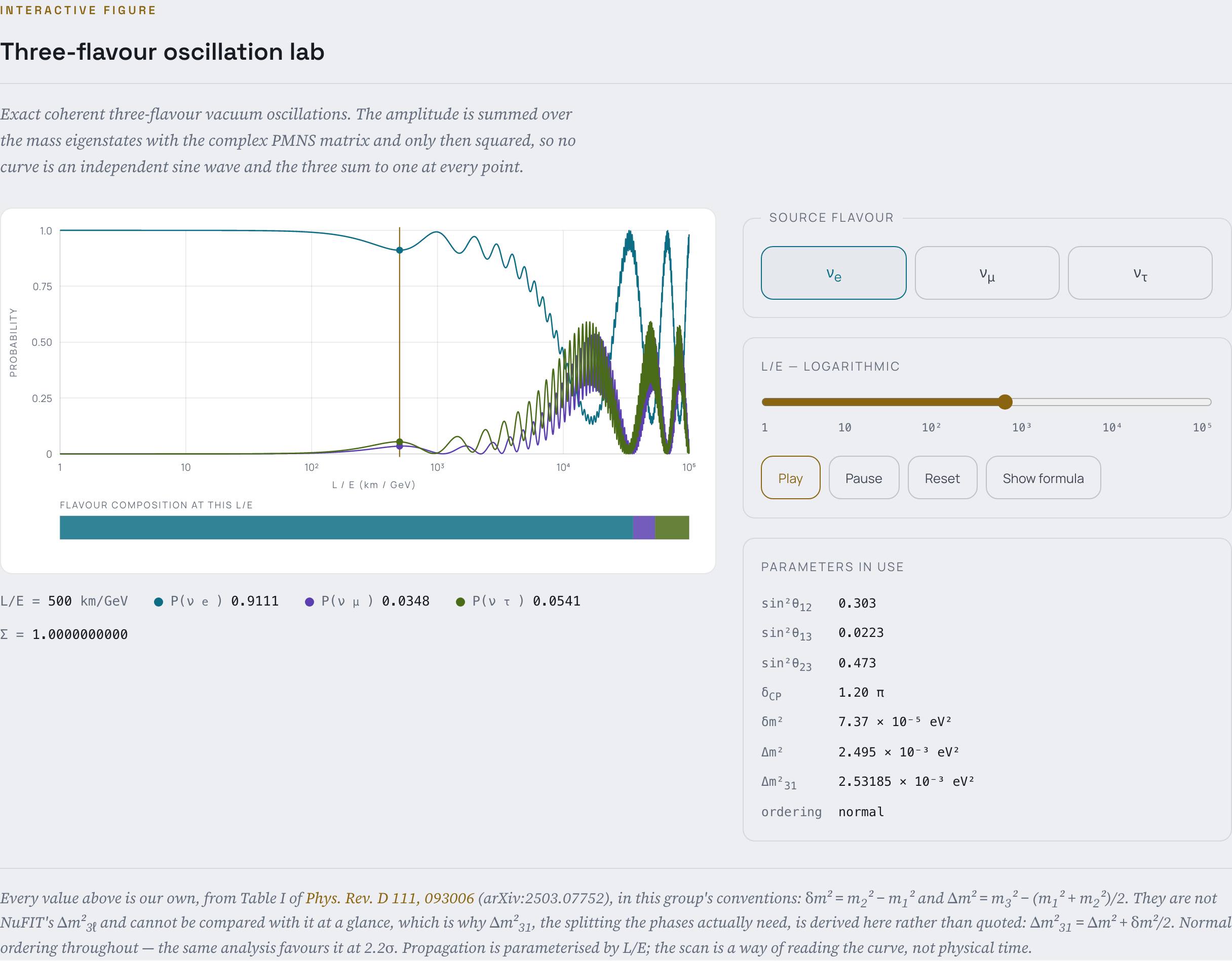
Exact three-flavour oscillation probabilities in vacuum as a function of L/E, with the parameters of the Bari global analysis.
Interactive figure
Three-flavour oscillation lab
Exact coherent three-flavour vacuum oscillations. The amplitude is summed over the mass eigenstates with the complex PMNS matrix and only then squared, so no curve is an independent sine wave and the three sum to one at every point.
A(να→νβ) = Σi Uβi exp[−i · 2.534 · Δm²i1 · L/E] U*αi
P(να→νβ) = |A(να→νβ)|²
L in km, E in GeV, Δm² in eV². The three amplitudes are evaluated as complex numbers and only then squared, so no curve is an independent sine wave.
Parameters in use
- sin²θ12
- 0.303
- sin²θ13
- 0.0223
- sin²θ23
- 0.473
- δCP
- 1.20 π
- δm²
- 7.37 × 10⁻⁵ eV²
- Δm²
- 2.495 × 10⁻³ eV²
- Δm²31
- —
- ordering
- normal
Every value above is our own, from Table I of Phys. Rev. D 111, 093006 (arXiv:2503.07752), in this group's conventions: δm² = m2² − m1² and Δm² = m3² − (m1² + m2²)/2. They are not NuFIT's Δm²3ℓ and cannot be compared with it at a glance, which is why Δm²31, the splitting the phases actually need, is derived here rather than quoted: Δm²31 = Δm² + δm²/2. Normal ordering throughout — the same analysis favours it at 2.2σ. Propagation is parameterised by L/E; the scan is a way of reading the curve, not physical time.
About this figure
Three-flavour oscillation lab
Level. Advanced undergraduate: quantum mechanics and the idea of flavour mixing.
The amplitude is summed over the mass eigenstates with the complex PMNS matrix and only then squared, so no curve is an independent sine wave and the three probabilities sum to one at every point. Choose the initial flavour, scan L/E, and read the flavour composition at any point.
Assumptions
- Propagation in vacuum: no matter effects.
- Normal ordering only — the ordering favoured by the same analysis, at 2.2σ.
- Best-fit values of Table I of Phys. Rev. D 111, 093006: sin²θ12 = 0.303, sin²θ13 = 0.0223, sin²θ23 = 0.473, δ/π = 1.20, δm² = 7.37×10⁻⁵ eV², Δm² = 2.495×10⁻³ eV², with Δm² = m₃² − (m₁² + m₂²)/2.
References
Where it fits
- BSM Neutrino Physics, module M7 (minimal oscillation review)
- Research — global analysis of neutrino oscillations
Cite and reuse
A. Marrone, Three-flavour oscillation lab, interactive figure (2026), https://home.ba.infn.it/~marrone/interactive-oscillations.html.
@misc{Marrone:oscillations,
  author       = {Marrone, Antonio},
  title        = {Three-flavour oscillation lab},
  howpublished = {Interactive figure, \url{https://home.ba.infn.it/~marrone/interactive-oscillations.html}},
  year         = {2026}
}
Text and figures: CC BY 4.0. Code (assets/js/oscillation-lab.js): MIT licence. Use it in lectures and talks, adapt it, redistribute it — with attribution.