Interactive neutrino physics · Cosmology
What happened to the neutrinos of the Big Bang?
A scrubbable history of the relic neutrinos, from the primordial plasma to the sea that fills every cubic centimetre of space today.
Cosmology · relic neutrinos
The cosmic neutrino background
from the primordial plasma to today
Stage 1 / 4 · thermal equilibrium
10.00MeV
≈ 0.01 s
—
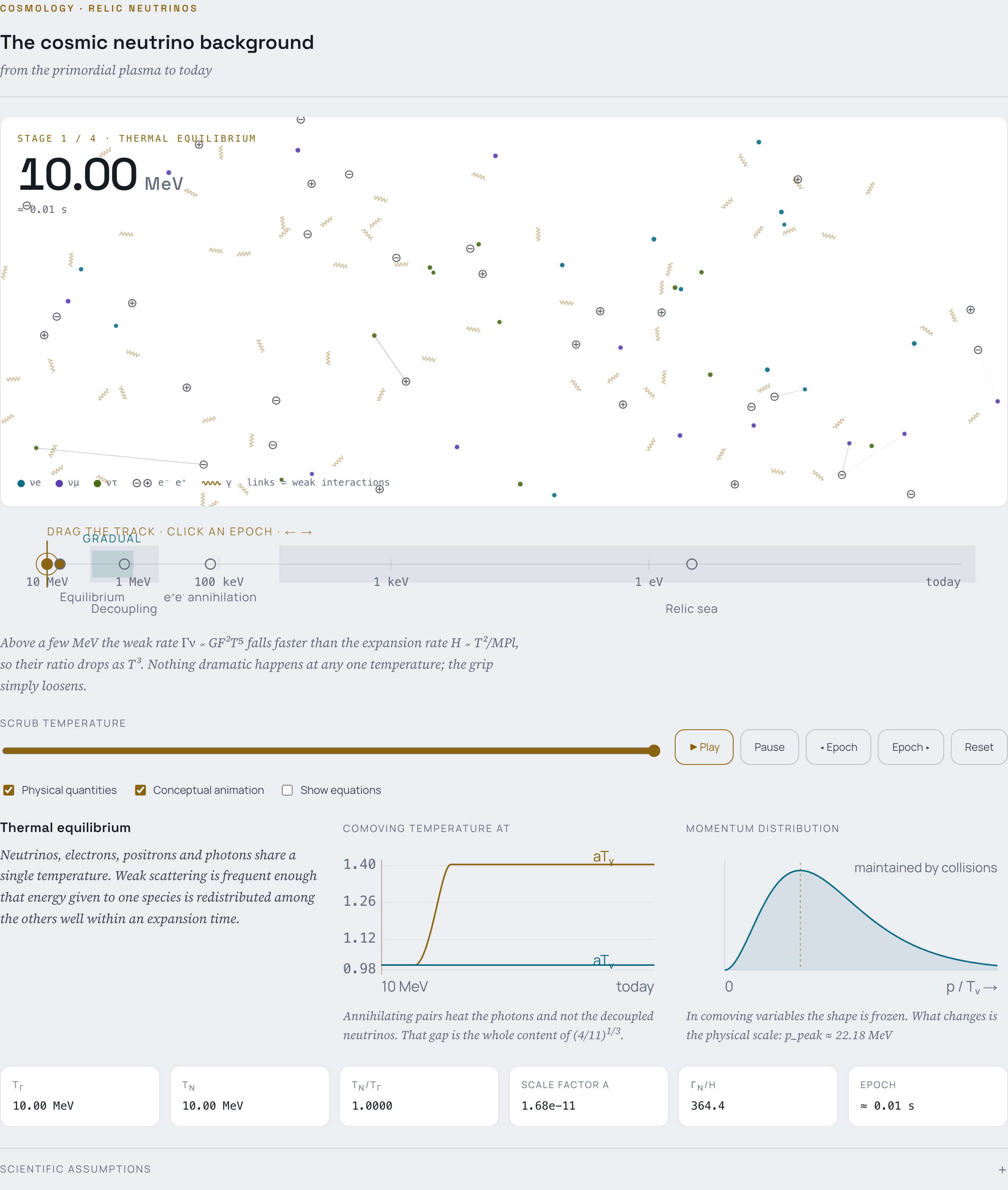
Thermal equilibrium
—
Comoving temperature aT
Annihilating pairs heat the photons and not the decoupled neutrinos. That gap is the whole content of (4/11)1/3.
Momentum distribution
In comoving variables the shape is frozen. What changes is the physical scale: —
Tγ
—
Tν
—
Tν/Tγ
—
scale factor a
—
Γν/H
—
epoch
—
- Standard ΛCDM background with three light active neutrinos and no extra relativistic species.
- Decoupling is not an instant. The estimate Γν/H ≈ (T/1.4 MeV)³ only locates where the two rates cross; the transition is spread over roughly 3 to 1 MeV, is momentum dependent, and differs by flavour because νe keeps its charged-current channel slightly longer.
- The ratio (4/11)1/3 assumes decoupling completed before e± annihilation. Solving the full kinetic equations gives small distortions to the Fermi–Dirac spectra instead.
- Neff ≈ 3.044 parameterises the total radiation density relative to one instantaneously decoupled species. It is not a count of particles and not a count of flavours; the shift above 3 comes from residual heating during annihilation, flavour oscillations and finite-temperature QED corrections.
- Neutrino masses are neglected in the thermal history. They matter for the present energy density and for structure formation, not for the temperature relations shown here.
- The quanta on screen are a schematic census of a few dozen particles, not a simulation, and animation speed is a reading pace with no relation to cosmic time.
About this figure
The cosmic neutrino background
Level. Graduate: the thermal history of the early Universe.
Neutrinos, electrons, positrons and photons first share one temperature; the weak rate then falls behind the expansion and the neutrinos decouple; e⁺e⁻ annihilation heats the photons but not the neutrinos, which stay permanently colder. Two panels follow the comoving temperature and the momentum distribution.
Assumptions
- Tν/Tγ = (4/11)1/3 ≈ 0.714 for instantaneous decoupling; Neff ≈ 3.044 accounts for the fact that decoupling is not instantaneous. Neff measures radiation density, not a number of particles.
- Tγ,0 = 2.7255 K (Fixsen 2009), hence Tν,0 ≈ 1.95 K and nν,0 ≈ 336 cm⁻³ for neutrinos and antineutrinos of all three species.
- The quanta drawn on the canvas are a schematic census, not a simulation.
Where it fits
- BSM Neutrino Physics, module M9 (leptogenesis and cosmology links)
- Research — absolute neutrino masses and cosmology
Cite and reuse
A. Marrone, The cosmic neutrino background, interactive figure (2026), https://home.ba.infn.it/~marrone/interactive-relic-neutrinos.html.
@misc{Marrone:relicneutrinos,
  author       = {Marrone, Antonio},
  title        = {The cosmic neutrino background},
  howpublished = {Interactive figure, \url{https://home.ba.infn.it/~marrone/interactive-relic-neutrinos.html}},
  year         = {2026}
}
Text and figures: CC BY 4.0. Code (assets/js/cnb.js): MIT licence. Use it in lectures and talks, adapt it, redistribute it — with attribution.