Interactive neutrino physics · Seesaw
How do three different seesaws become one operator?
The type I, II and III seesaw diagrams collapse onto the same dimension-five operator as the energy scale runs below the heavy mass.
Interactive figure
Where did the heavy particle go?
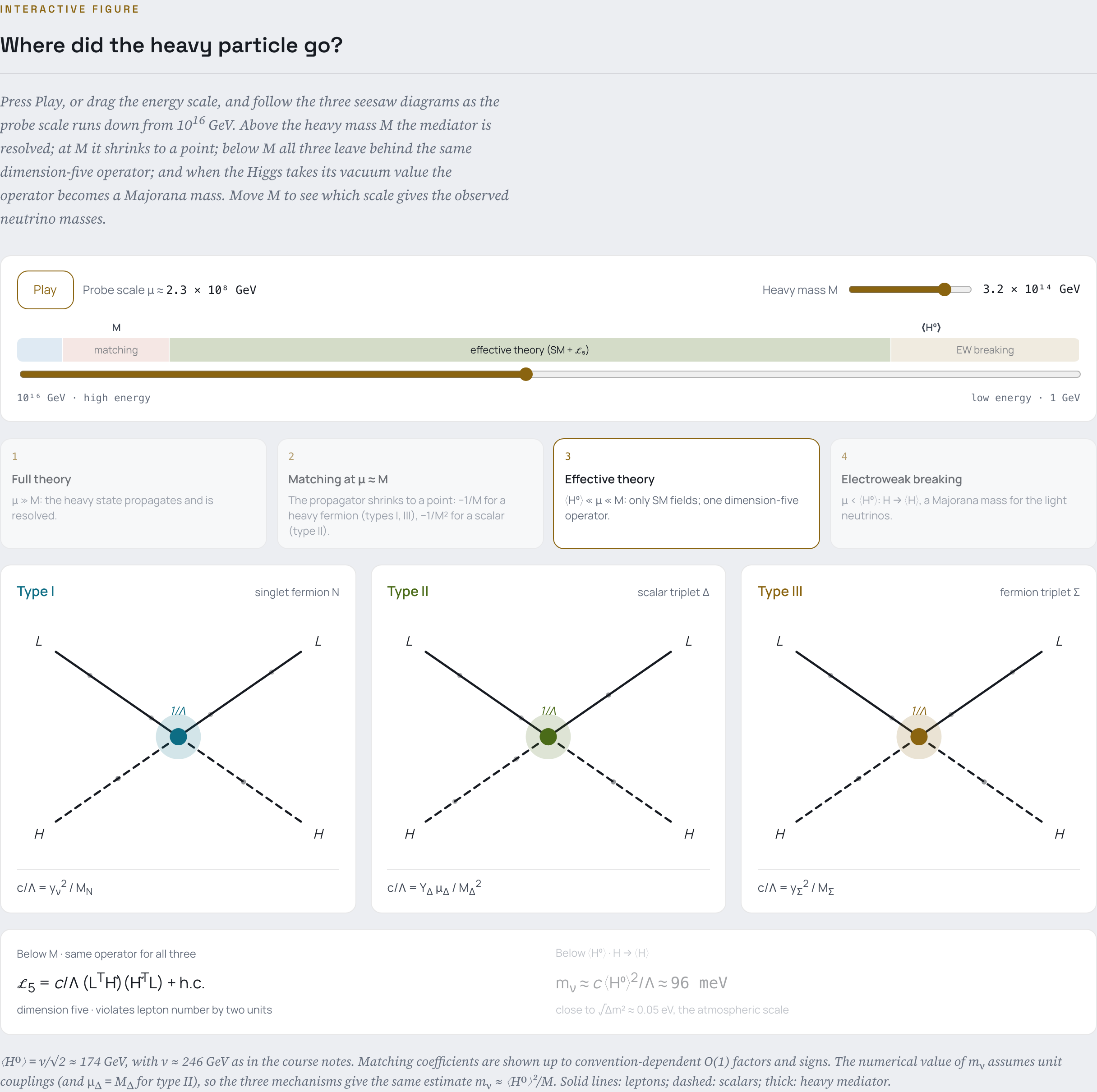
Press Play, or drag the energy scale, and follow the three seesaw diagrams as the probe scale runs down from 1016 GeV. Above the heavy mass M the mediator is resolved; at M it shrinks to a point; below M all three leave behind the same dimension-five operator; and when the Higgs takes its vacuum value the operator becomes a Majorana mass. Move M to see which scale gives the observed neutrino masses.
About this figure
Where did the heavy particle go?
Level. Graduate: quantum field theory and effective field theory.
Press Play or drag the scale: above the heavy mass M the mediator is resolved, at M it shrinks to a point, below M all three leave the Weinberg operator, and when the Higgs takes its vacuum value the operator becomes a Majorana mass. Moving M shows which scale gives the observed neutrino masses.
Assumptions
- Matching coefficients up to convention-dependent O(1) factors and signs.
- The numerical mν ≈ ⟨H⁰⟩²/M assumes unit couplings (and μΔ = MΔ for type II), with ⟨H⁰⟩ = v/√2 ≈ 174 GeV.
References
Where it fits
Cite and reuse
A. Marrone, Where did the heavy particle go?, interactive figure (2026), https://home.ba.infn.it/~marrone/interactive-weinberg-operator.html.
@misc{Marrone:weinbergoperator,
  author       = {Marrone, Antonio},
  title        = {Where did the heavy particle go?},
  howpublished = {Interactive figure, \url{https://home.ba.infn.it/~marrone/interactive-weinberg-operator.html}},
  year         = {2026}
}
Text and figures: CC BY 4.0. Code (assets/js/weinberg-zoom.js): MIT licence. Use it in lectures and talks, adapt it, redistribute it — with attribution.